
Define the problem.
Choose one process, change, handoff or supplier decision. Agree what needs to be understood and who can authorize the work.
How We Work
We work on a defined part of your business, explain what we examine, and leave your team with findings and records it can use.
Choose one process, change, handoff or supplier decision. Agree what needs to be understood and who can authorize the work.
Review the relevant people, systems, information, permissions and decision points. Separate verified findings from missing information.
Complete the assessment, support the approved change, prepare the handoff or rehearse the supplier transition within the agreed scope.
Explain what was checked, what remains unresolved, who owns the next actions and what needs to stay current.
The research standards our founder, Dr. Benjamin Royer, learned at Cornell University are a lifelong commitment. They shape how ConfigCap frames questions, examines evidence, and reaches conclusions.
We know what we can do. We know what we cannot.
Knowing where a finding holds, and where more evidence is needed, is part of the work from the beginning. We distinguish observations from assumptions, keep conclusions within the evidence, and make the reasoning open to scrutiny.
The research is the foundation. Your operation is where it must prove useful.
ConfigCap does not provide a universal trust score, prove truth through credentials, certify legal compliance, or replace qualified legal, audit, engineering, safety, or conformity judgment.
Explore the research concepts and technical detail behind the approach, including the assumptions and evidence that give each finding its meaning.
Our approach is grounded in the CSF research corpus. In practical terms, that means looking beyond a single AI model to the people, information, permissions and review routes that determine what happens next.
The research informs the work; it does not replace customer evidence. Each finding identifies what was checked and what remains unresolved. Where further engineering or specialist judgment is needed, it is separately scoped.
Canonical distinction
T_nThe cycle-level outcome at a declared decision point. It is produced, not assigned by score.
R_nVerified, eligible, scoped, variable-quality, depreciating residue that may cross the cycle boundary.
K_tauThe broader rights-bounded enterprise learning stock. Related to the other registers, never interchangeable with them.
Minimal cyclical map
The current configuration produces a cycle-level outcome. Only verified, scoped, eligible, and depreciating residue may condition the next cycle.
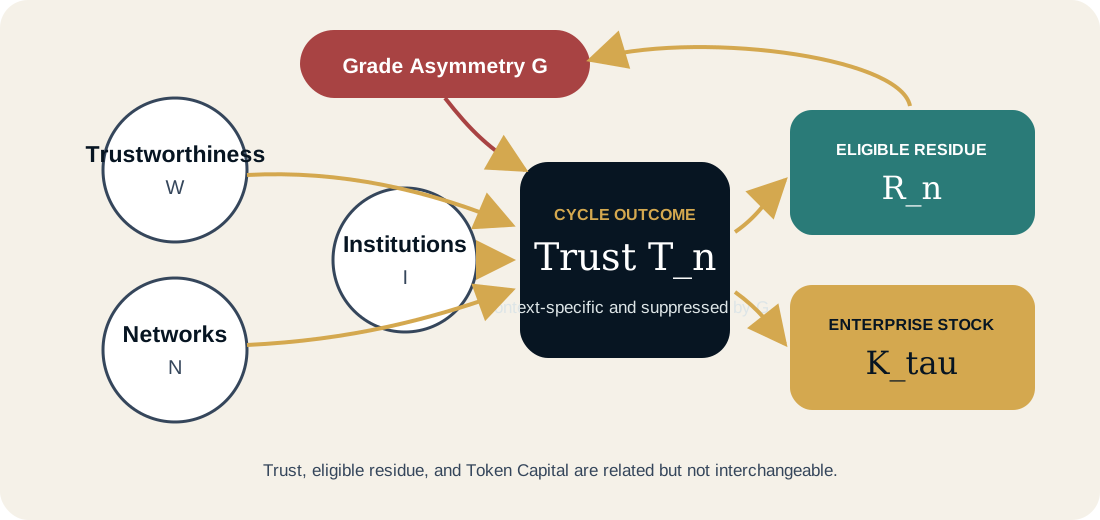
Relational Diagnostic Toolkit
The components identify distinct failure modes. They remain visible rather than being hidden inside one number.
Cycle-boundary eligibility
A state crosses the cycle boundary only after six explicit evaluations for the declared context.
The state or output exists in the declared workflow.
Evidence supports the stated result and provenance.
The evidence remains current and bounded to the decision context.
Material challenges can be heard, resolved, and reflected in eligibility.
Use, transfer, retention, and remedy rights are explicit.
The state satisfies the governing policy for this cycle boundary.

Evidence before confidence
Source, scope, confidence, time window, method version, status, challenge state, rights basis, and retention class remain attached where relevant.
Simulation-derived thresholds, design targets, and mechanistic parameterizations remain labeled until external replication and domain-specific telemetry support stronger claims.